
A digital growth system connects your website, marketing, lead follow-up, business automation, and reputation management so your business can attract more customers and grow more consistently. Finish Work Studio uses one connected plan to show where customers find you, where leads stall, and which fix comes first.
A small business can own a website, run ads, post on social media, buy a CRM, and still lose good leads. Each tool may work by itself. The problem shows up in the gaps between them.
A customer sees the business on Google, checks a review, opens the website on a phone, sends a form, and waits. If the form lands in an inbox nobody checks, the marketing did its job and the business still lost the opportunity.
That is why this article is about the system, not the shopping list.
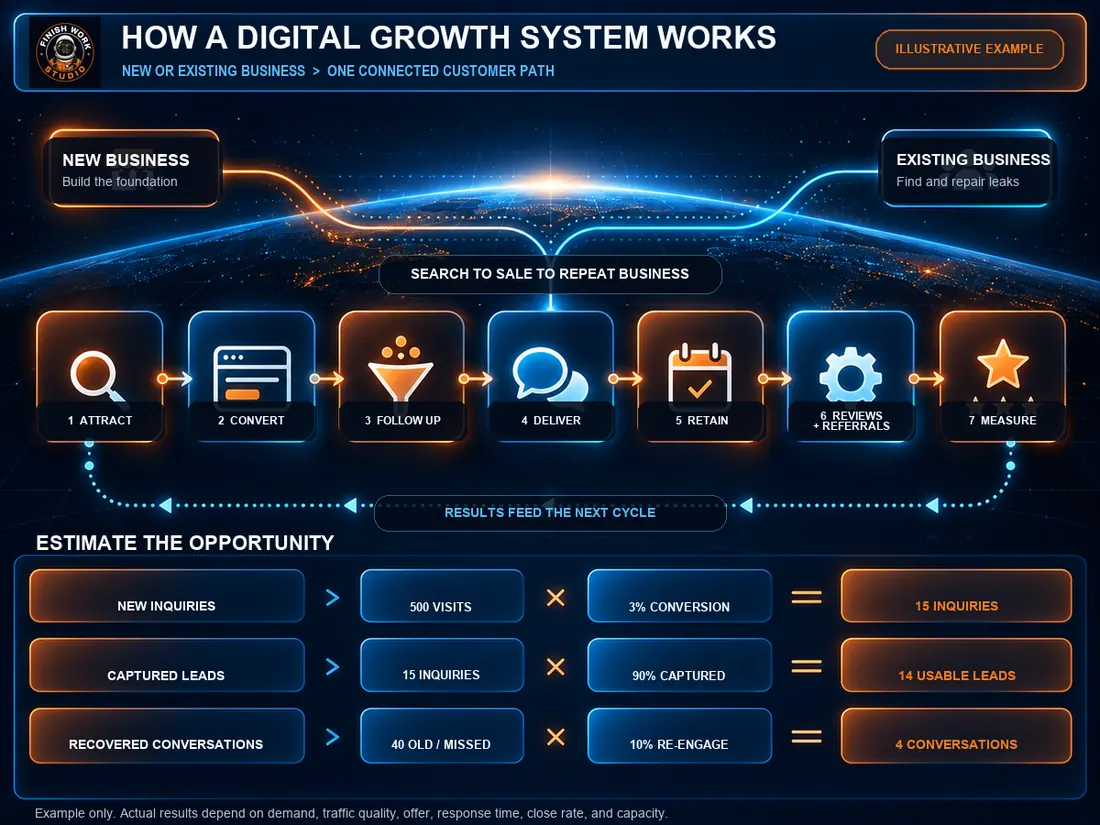
How Many Leads Could the System Capture or Recover?
The honest answer starts with your real traffic and your real missed opportunities. A diagram cannot promise a lead count. It can show exactly where to measure one.
For a new business, estimate new inquiries by multiplying qualified visits by the percentage of visitors who call, submit a form, send a message, or book. Then check how many of those inquiries reach a shared record and receive a clear owner. For an existing business, also count old form submissions, missed calls, unanswered messages, open estimates, and leads that never received a second follow-up.
Illustrative example: 500 qualified visits at a 3% conversion rate create 15 inquiries. If 90% are captured and routed correctly, that is about 14 usable leads. If the business also has 40 old or missed leads and 10% restart the conversation, that creates 4 recovered conversations. These are example assumptions, not a forecast.
Two businesses with the same traffic can produce very different results. Demand, traffic quality, the offer, response time, sales follow-up, pricing, reviews, and the team's capacity all affect the outcome. The useful number is the one built from your own records, then checked again after the first leak is repaired.
What Does “Digital Growth System” Mean in 2026?
A digital growth system is a practical way to connect the steps that bring in and keep customers. It is not a software brand, a Google product, or a formal industry standard. It is the name Finish Work Studio uses for a seven-stage framework built around the full customer path.
The seven stages are attract, convert, follow up, deliver, retain, reviews and referrals, and measure. Each stage has one job. Each stage hands something useful to the next.
The word digital does not mean every conversation must be handled by software. It means the website, listings, forms, messages, calendar, customer records, reviews, and reports share enough information that people do not have to rebuild the same story at every step.
The simple test: Can the business trace a real customer from the first search to the sale, service, review, and return visit? If the answer disappears halfway through, the system has a gap.
Why Does a Connected System Matter Now?
Customers do not stay on one channel while choosing a business. They move between Google, Maps, reviews, social media, AI tools, and the business website, often in the same search.
BrightLocal's 2026 research with 1,227 U.S. consumers found that 75% used more than one channel during their most recent local business search. In that study, 73% started on a phone. Google Search and Google Maps remained the leading starting points, while social media, review sites, and AI tools also appeared along the path.
A separate BrightLocal study of more than 1,200 active local searchers found that only 6% simply clicked the first result. Seventy-two percent looked at three or fewer businesses. That short list makes consistency matter. The hours, services, proof, pricing, and contact path should tell the same story wherever the customer checks.
Reviews are part of that path too. BrightLocal's 2026 review survey found that 97% of consumers read reviews for local businesses, and 54% visited a business website after reading positive reviews. A review may create trust, but the website still has to make the next step clear.
What Are the Seven Stages of a Digital Growth System?
The seven stages cover the work before, during, and after a sale. The goal is not to make the model look fancy. The goal is to make every handoff visible.
| Stage | Job | Common leak |
|---|---|---|
| 1. Attract | Help the right people find the business. | The business is missing from search, Maps, or AI answers. |
| 2. Convert | Turn attention into a call, form, message, or booking. | The offer is unclear or the next step is hard on a phone. |
| 3. Follow up | Acknowledge, qualify, route, and answer the lead. | The lead waits or lands in the wrong inbox. |
| 4. Deliver | Give the customer a clear, consistent service experience. | Onboarding, updates, or handoffs depend on memory. |
| 5. Retain | Keep good customers connected after the job. | There is no reminder, check-in, or repeat-service plan. |
| 6. Reviews and referrals | Turn a good result into trust and new introductions. | Happy customers are never asked at the right time. |
| 7. Measure | Connect sources, leads, sales, and customer value. | Reports show clicks, but nobody can show what became revenue. |
The stages form a loop. Better service creates better reviews. Better reviews help attract the next customer. Clear source tracking shows which work deserves more time and money.
The framework also keeps automation in its proper place. Automation may support lead routing, reminders, review requests, and reporting. It should not replace a human decision simply because a tool can send a message.
How Is It Different From Marketing or a Business Operating System?
Digital marketing creates attention and demand. A digital growth system carries that attention through response, service, retention, reputation, and measurement.
A business operating system is wider. It may cover staff roles, finances, meetings, quality control, hiring, and how the company completes its work. The digital growth system sits inside that larger operation and focuses on the connected customer-facing steps that produce and keep revenue.
A tool stack is different too. A tool stack is the list of software the business owns. A system states what must happen, who owns it, what triggers the next step, and how success is measured. The business can change tools without losing the system.
This difference matters in 2026 because buying a tool is easy and putting it to work is harder. The OECD's 2026 D4SME survey covered more than 2,000 small and midsize businesses across 12 countries. The sample was not representative of every small business, but the finding is useful: adoption of off-the-shelf AI tools was rising while strategic, secure integration into operations remained uneven.
What Does the System Look Like for a Local Business?
For a local service business, the first version can be simple. It may use a Google Business Profile, a clear website, one accepted lead form, a shared contact record, a calendar, written follow-up steps, and a weekly scorecard.
Take a hypothetical service company in Cocoa. A homeowner finds it on Google Maps, checks its reviews, and opens the website. The mobile page explains the service and accepts a quote request. The customer sees a confirmation with the expected response time. The lead reaches the right person with its source attached.
After the estimate, the business records whether the lead booked. Once the work is complete, a review request goes out at the agreed time. The owner can see how many Maps visits became inquiries, estimates, completed jobs, and reviews.
None of that requires a huge platform. It requires clear handoffs. Software earns its place only when it makes one of those handoffs faster, safer, or easier to measure.
How Do You Build the First Version?
Build the first version by mapping what happens today, finding the earliest real leak, and fixing one handoff at a time. Start with the customer, not the software.
- Write down every entry point. Include calls, forms, Google messages, social messages, email, referrals, and walk-ins.
- Follow one recent lead. Record who received it, how long the reply took, what happened next, and where the result was saved.
- Mark the missing handoffs. Look for delays, duplicate typing, forgotten messages, and steps that live in one person's memory.
- Choose one business result. More qualified calls, faster response, more booked estimates, or more review requests are clear starting goals.
- Fix the first leak. Do not automate five weak steps at once. Repair the earliest point where a good opportunity disappears.
- Track the before and after. Use the same metric for several weeks so the business can tell whether the change helped.
Federal Reserve Bank of San Francisco research published in July 2026 found that nearly 40% of respondents in the 2024 Small Business Credit Survey were using or planning to use AI. The report also recorded cost, staff time, system upgrades, training, and implementation knowledge as barriers. That is another reason to start with a named problem instead of a new subscription.
Do You Need a CRM, AI, or New Website?
Use new technology only when it solves a problem the business can point to. Some companies need a better website first. Others need a shared lead record, a faster response, or simple reporting.
JPMorganChase Institute published a 2026 study using transactions from 4.6 million small businesses. By December 2025, its cumulative paid-AI adoption measure reached 26.1% for employer firms and 15.3% for nonemployer firms. The measure excludes free tools and embedded AI, so it does not describe all use. It does show that paid adoption is moving quickly.
Fast adoption does not make every tool useful. A CRM helps when several people need the same customer record. AI helps when a clear, repeatable task needs faster handling. A new website helps when the current one cannot explain the offer, work well on a phone, capture a lead, or support measurement.
If the process is unclear, write it down before automating it. A fast tool attached to a weak process creates faster confusion.
How Do You Know the System Is Working?
A working system loses fewer good opportunities between discovery and revenue. The owner should be able to see where leads came from, how quickly they received a reply, what they booked, and whether they returned or referred someone.
Start with a short weekly scorecard:
- qualified visits and profile actions;
- new inquiries by source;
- average first-response time;
- appointments or estimates booked;
- completed sales and close rate;
- review requests sent and reviews received;
- repeat customers and referrals; and
- revenue by source when the records support it.
Do not start with every number a dashboard can show. Start with the numbers that reveal a handoff. If visits rise but inquiries do not, inspect the offer and website. If inquiries rise but bookings do not, inspect response and qualification. If customers are happy but reviews stay flat, inspect the request step.
The point is not to collect more data. The point is to know what to fix next.
Common Questions
What is a digital growth system for a small business?
A digital growth system connects your website, marketing, lead follow-up, business automation, and reputation management so your business can attract more customers and grow more consistently. Finish Work Studio also includes delivery, retention, referrals, and measurement so each part supports the next.
Is a digital growth system the same as digital marketing?
No. Digital marketing helps people discover the business. A digital growth system also covers the website, lead capture, response, booking, service, reviews, repeat business, and reporting. Finish Work Studio treats marketing as one stage inside the larger system, not the whole plan.
What should a small business connect first?
Start where the first real leak appears. Finish Work Studio checks whether the business is being found, whether visitors become leads, and whether those leads get a prompt response. The first useful connection may be a form, missed-call text, booking step, or simple source tracker.
Does a small business need a CRM or AI?
Not always. A spreadsheet, shared inbox, calendar, and written follow-up steps may be enough at first. Finish Work Studio recommends a CRM or AI only when it removes a real delay, repeated task, lost handoff, or reporting gap that the business can name and measure.
How do you know whether a digital growth system works?
Track the full path from source to sale. Finish Work Studio looks at qualified visits, inquiries, response time, appointments, close rate, reviews, repeat customers, and revenue by source. The system works when fewer opportunities disappear between those steps and the business can see why.
How Finish Work Studio Can Help
Finish Work Studio maps the customer-facing system first, then builds or connects the pieces that will remove the earliest useful leak.
- Branding: gives the business one clear identity across search, social profiles, reviews, and the website.
- Web design: creates a fast, mobile-first place that explains the offer and turns attention into real inquiries.
- Digital marketing: helps the right people find the business through search, Maps, content, advertising, and AI answers.
- Business automation: routes leads, sends useful acknowledgments, supports follow-up, and keeps repeated steps from depending on memory.
You do not have to buy everything. The free Growth Audit shows which stage is leaking and what is worth fixing first. The Digital Growth System service page explains how Finish Work Studio connects the stages, and the packages page shows the available ways to start.
- 2026 sources:
- BrightLocal, Where Are Your Customers Really Searching? (2026) — representative panel of 1,227 U.S. consumers who searched for a local business online in the prior three months.
- BrightLocal, What Makes Consumers Choose Your Business? (July 15, 2026) — more than 1,200 active local searchers.
- BrightLocal, Local Consumer Review Survey 2026 (February 11, 2026).
- OECD, Empowering SMEs in the Age of AI: The 2026 OECD D4SME Survey (April 13, 2026) — non-representative sample of more than 2,000 SMEs across 12 countries.
- Federal Reserve Bank of San Francisco, AI Adoption Among Small Businesses (July 15, 2026) — analysis of qualitative responses from the 2024 Small Business Credit Survey.
- JPMorganChase Institute, Understanding the Use of AI Among Small Businesses (2026) — transaction-based study covering 4.6 million firms from 2019 through 2025.
The 5-Point Website Checklist
Check whether your website supports the convert stage of the system. Enter your email and we will send the PDF, no strings.